How to Cook Buckwheat (Kasha)
![]() |
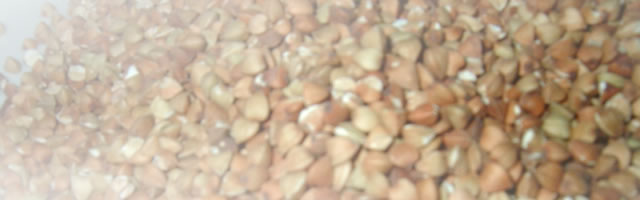
| Despite the name, buckwheat is not related to wheat and is often sought as a gluten-free alternative to wheat. While buckwheat is technically a seed, its high carbohydrate nutrient profile makes it more like a grain in the culinary sense. High in iron, manganese, magnesium, phosphorus, copper, and zinc, buckwheat is a healthy addition to any soup, or great as a side. Buckwheat can also be cooked in a shallow sauce pan to have a firmer texture, please refer to this article for more information. |
| Total Cooking Time: |
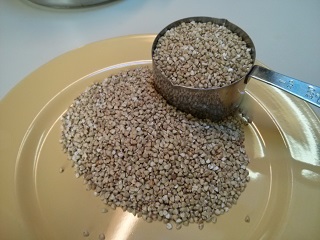
| Step 1: Get a cup of buckwheat and rinse it 2-3 times, draining the water quickly to preserve texture. If the buckwheat has been roasted (kasha) you are good to go, otherwise consider roasting/toasting the buckwheat in a shallow sauce pan to firm its texture and enchance its flavor. |
![]() |
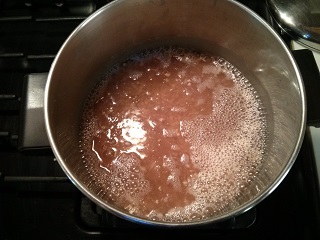
| Step 2: Place the buckwheat in a pot, add 2 cups of water, set to medium high heat, and add a lid. Alternate: Bring 2 cups of water to a boil, then add the buckwheat, put on the lid, and turn the heat down. After 15 minutes remove from heat and let sit for another 10 minutes. This will make the buckwheat firmer with a more crunchy texture. |
![]() |
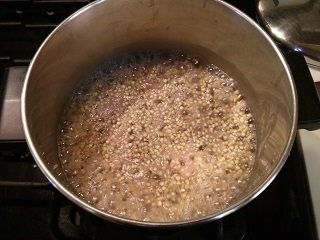
| Step 3: After 15-20 minutes all the water should be absorbed and the buckwheat will be cooked. Alternate: Slowly cook the buckwheat in a shallow sauce pan. This will cause the buckwheat to absorb less liquid and firm its texture. |
![]() |
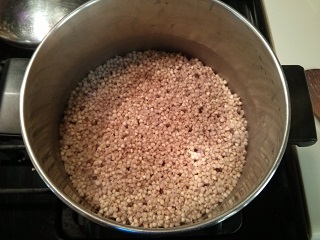
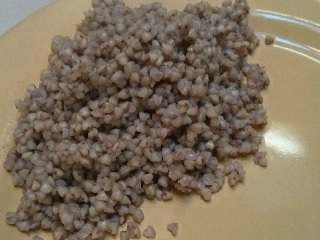
| Step 4: You are now done, and have cooked buckwheat, a hearty grain that is great on cold days. It pairs well with dark leafy greens as well as beans and legumes. Click to see complete nutrition facts for Buckwheat Buy Buckwheat from Amazon.com |
![]() |
| More recipes... |
| Name: | Anon Ymous |
| Subject: | Alternate Suggestion |
| Your buckwheat came out mushy! Kasha should have a fluffy, rice-like quality. Try bringing the water to a boil first, then adding the buckwheat, reduce heat to simmer, cover for 15 minutes, then let stand away from heat, but still covered, for 10 minutes. Then fluff with a fork and season to taste with salt. A better recipe is coating the kasha with a (whisked) egg over medium heat in a skillet, then adding the water or broth and following the recipe above. | |
| Posted on 2011-06-30 19:20:58 |
| Name: | VB |
| Location: | Russia |
| Subject: | The correct way |
| Your recipe is incorrect. This is how you make buckwheat: DO NOT WASH BUCKWHEAT. Buy roasted buckwheat, it is tastier. Boil three cups of water. Add some salt. Add two cups of buckwheat to the boiling water. Stir, leave on high uncovered. As soon as the grain expands and soaks up the water at the top, cover with the lid and leave it on the lowest setting possible for another five to ten minutes (check that all the water has been absorbed) at the bottom. The buckwheat should be fluffy and the kernels should not stick to each other. You can add other things to your buckwheat before serving - fried onions, mushrooms, vegetables, cold pressed sunflower oil. It SHOULD NOT BE MUSHY AT ALL! Good luck! | |
| Posted on 2011-08-06 18:53:02 |
| Name: | VB |
| Location: | Russia |
| Subject: | Correction |
| Sorry, I wrote "leave it on the lowest setting for another five to ten minutes". This is incorrect - it could be longer depending on the pot. Try to use some heavy pots. Also, if you are using ceramic stove top, you can leave it on setting 1 for up to forty minutes, then turn off the heat but do not remove from the stove top. Traditional Russian method of cooking is, when the grain expands and soaks up the water on the top, to leave it on a lowest setting possible for an hour (they used special ovens to keep it warm). | |
| Posted on 2011-09-10 23:22:27 |
| Name: | Sam Gifford |
| Location: | Scotland |
| Subject: | Cooking Buckwheat |
| Here in the UK we have lots of Polish shops where you can buy boil in the bag buckwheat. It's called Kasza and you can buy the brown or lighter-cloured varieties. Had some last night with some Puy Lentils etc. Lovely! | |
| Posted on 2011-12-14 22:05:10 |
| Name: | Ms. Dori |
| Location: | San Diego, CA |
| Subject: | Ewww! Too Mushy! |
| I agree...I tried the recipe for cooking buckwheat and mine came out mushy as well. Thanks to those who put up another way to cook the buckwheat so that it turns out more like rice that doesn't stick together. I will try the suggestions nest time I cook buckwheat! Thanks for all your information! | |
| Posted on 2012-01-24 22:35:12 |
| Name: | SF |
| Location: | Minneapolis, MN, USA |
| Subject: | The Russian way works! |
| I used to make buckwheat similarly to the first recipe above, and indeed, it would come out kind of mushy. The method suggested by "VB" above works great and yields buckwheat that tastes so much better! In my pot, it was hard to see whether the buckwheat had consumed all the water on top, due to a large number of bubbles... so I turned the heat down to medium-high until I could see. Then when the water on top was mostly absorbed, I put a lid on and left it for 10 minutes on the lowest setting. The result, perfect tasting buckwheat with a great texture. | |
| Posted on 2012-04-07 23:59:14 |
| Name: | Banana |
| Location: | Israel |
| Subject: | Thank you VB for the Russian way! |
| The original recipe on this page made the buckwheat SUPER mushy...! What was I thinking, washing it???! Don't let it touch water until it hits the pot! | |
| Posted on 2012-04-21 20:35:48 |
| Name: | HealthAliciousNess |
| Subject: | Selecting, Cleaning, and Storing Buckwheat |
| Thanks to everyone whos comments have made the webpage more useful. Also wanted to point out this site which has good guidelines on selecting, storing, and cleaning buckwheat/kasha. Basically, it endorses rinsing buckwheat but quickly draining the liquid to preserve texture. This is likely best as not all grains can be 100% clean and an extra rinse is a good precaution. The site also points out that it is best to store kasha/buckwheat in the freezer. Hope that helps and thanks again for the comments and suggestions. | |
| Posted on 2012-04-21 21:00:35 |
| Name: | VB |
| Location: | Russia |
| Subject: | RE: Selecting, Cleaning, and Storing Buckwheat |
| @HealthAliciousNess - 150 million people in Russia NEVER EVER washed or rinsed buckwheat for at least 200 years. Some people go through a quick "sorting" - you put a bunch of buckwheat at a time on a big flat plate to find foreign inclusions that you pick out manually. This is only done when the grain is full of small pebbles or there is other grain mixed in together. However, there is no water involved in this process. Nobody stores buckwheat in the freezer. It is like rice. Would you store your rice grains in the freezer? | |
| Posted on 2012-05-15 15:33:59 |
| Name: | HealthAliciousNess |
| Subject: | RE: Selecting, Cleaning, and Storing Buckwheat |
| Hi VB, thanks for your comment and input. You have a great perspective on buckwheat, would you be willing to write an article on buckwheat explaining the care and cooking of buckwheat? Can you produce your own step by step recipe with photos? Would be happy to compensate you for your work. Please send a message if you are interested. Also, I do store rice in the freezer, it helps prevent weavles and other bugs from appearing there and doesn't harm the quality. | |
| Posted on 2012-05-16 03:07:06 |
| Name: | Garrick Marchena |
| Location: | Island of Curaçao in the Caribbean |
| Subject: | Re-heating cooked buckwheat |
| I've just started to eat buckwheat (as in today!) I've read that cooked buckwheat can be stored and re-heated the next day. My queastion is: How do you re-heat fridge-stored coocked Buckwheat properly? | |
| Posted on 2012-07-25 19:04:23 |
| Name: | Lance Brown |
| Location: | United States |
| Subject: | alt recipe: firm kernels, not mushy |
| VEGAN RAW BUCKWHEAT RECIPE - rinse and allow to air dry in a strainer for a couple of hours (i.e. in morning to cook in evening). Place damp buckwheat in Le Creuset oven-proof iron pot. place pot in oven, set temp for 450 degrees. When oven is preheated start process of stirring every 10 minutes. When kernels begin to turn golden, then increase stirring frequency to every 3 minutes until *some* kernels start to appear a dark orange color and most others are a degree of golden to orange color. While buckwheat is roasting, heat plenty of water on the stove to the boiling point in a pot that easily pours. When the buckwheat is fully roasted, remove from oven, place on stove top and uncover. measure water in pyrex glass measuring cup (2 cups water / cup of grain) & add to ***HOT*** roasted buckwheat. stand back from pot as VERY HOT steam will be rising from the pot. recover pot, place in oven & turn off oven heat. Cook in hot oven for 20 minutes. Remove from oven & let stand for 10 minutes. | |
| Posted on 2012-09-30 02:15:12 |
| Name: | Lance Brown |
| Location: | United States |
| Subject: | Storing Grains |
| Yes, grains are best stored in the freezer as sometimes weevil eggs accompany the harvested grain. If the grain is stored at room temperature, then SURPRISE hatched bugs eating away your grain at some inopportune point.
I have never heard of this with buckwheat specifically, but have witnessed it occurring first hand with rice & barley over my 20+ years of a grain based diet. | |
| Posted on 2012-09-30 02:21:38 |
| Name: | VB |
| Subject: | Sorry |
| I apologize that I would not be able to write an article on buckwheat since I have been grain-free from October 2011. I suppose you can store buckwheat in the freezer, but only if you eat it infrequently. Since Russians eat it every single week, they go through it pretty quickly (2 lb bag per month) so it does not require storage. If they keep buckwheat in large bags, then of course there are tiny bugs that hatch over the period of 9-10 months, but not always, depending on the grain. One more caveat: most Russians use 3 cups of water to 2 cups of dry buckwheat. Some Russians use 2 cups of water to 1 cup of buckwheat (then you have to keep it longer on the lower setting). I prefer 3:2. Always buy roasted, especially if this is your first time making it - it tastes way better. Also, after it is finished, you can use butter, olive oil, vegetables, any sauce you like. Many Russians eat it hot with cold milk for breakfast (like cereal). Or you can add it to your morning omelet. It is delicious. | |
| Posted on 2012-10-06 03:11:10 |
| Name: | RK |
| Location: | Israel |
| Subject: | Roasting and Cooking Buckwheat My Way... |
| My family is from Russian origin and I would like to tell you how I just made buckwhet (it came out very good fluffly, not sticky at all). I didn't find pre-roasted buckwheat so I bought regular buckwheat, washed it very quickly, about a minute and put it on a dry frying pan to dry out and roast (with a small fire of course). After it's dry, I just put it in a container until I'm ready to cook it. To cook it I added the roasted buckwheat to boiling water, added some salt and cooked covered for 10 minutes and then let it stand covered for another 10 minutes. The water buckwheat ratio I used was 1.5:1, so one and a half cups of water to 1 cup of buckwheat. I hope this helps. The roasting step is very important if you cannot buy already roasted buchwheat. | |
| Posted on 2012-10-10 13:49:35 |
| Name: | Pari |
| Location: | L.A. |
| Subject: | Buckwheat as Cereal |
| Yup, VB is right. I used to just put buckwheat with water in a pot and wait till water evaporated. Too soft/mushy. I did 1.5c water and 1c. kasha and it came out great. I buy it already roasted from Jons and sometime it stays around for months when I'm not in the mood for BW. NO bugs ever! I keep the bag (2lbs) in the pantry or on the counter. As you may know some days can get really hot in L.A. but I never had a problem. I prefer mine on the sweet side instead of salty so I use it like cereals. I add soy milk (lactose intolerant), diet sugar (out of necessity) and slice a banana on top or some other fruit. Maybe jam once in a while. | |
| Posted on 2012-11-09 03:07:08 |
| Name: | Looly |
| Location: | Sweden |
| Subject: | Buckwheat |
| I cook my buckwheat mushy for porridge and grainy for rice. For a porridge I add unrefined sea salt (84 to 92 minerals) and on my plate I mix in tahini and sometimes carob powder and chopped sweet fruit. That is a treat. | |
| Posted on 2012-11-25 05:00:12 |
| Name: | Ouiser |
| Location: | Israel |
| Subject: | VB is absolutely right!! |
| This way buckwheat turns out fluffy and delicious, btw that's how I also cook basmati rice or any other rice for that matter and it tastes just perfect. | |
| Posted on 2012-11-26 09:26:06 |
| Name: | OJB |
| Location: | Israel |
| Subject: | Non-sticky buckwheat |
| Sautee in a pot leeks, grated carrots, and different mushrooms on little oil. Add salt and black pepper. After RINSING buckwheat under faucet water, add 1 cup of buckwheat, and 1.5 cup boiling water to the pot. After it comes to boil, lower the heat to minimum and cook for about 20 minutes. Turn off the heat, leave covered for another 20 minutes, and then fluff it gently with a fork. Does not stick or get mushy, and is super-delicious. | |
| Posted on 2012-12-26 02:49:20 |
| Name: | OJB |
| Location: | Israel |
| Subject: | Non-sticky buckwheat |
| I would like to add a note to my above comment. If you use chicken broth instead of water, it is even tastier. Instead of leeks, you can use onions. Also, you can add to the rest of the ingredients and sauté finely chopped stalk of celery and/or grated zucchini. The possibilities are unending. | |
| Posted on 2012-12-27 01:07:28 |
| Name: | Foozle |
| Location: | U.S. |
| Subject: | Coat in Egg for Better Texture |
| I grew my own buckwheat this year, so was able to experiment with different methods using consistent raw buckwheat to start. Plain roasted buckwheat tended to get fairly mushy, even if using a low amount of water. Less water was better, but still mushy. The best method I found for making it less mushy was roasting the buckwheat in the oven for about 40 minutes on 325 degrees (convection oven), letting cool a bit, coating with beaten egg, then frying in a dry pan for a few minutes to cook the egg into the buckwheat, creating a shiny coating on the groats. Apparently there is a chemical in the egg whites called Albumin, that acts like a binding agent, keeping the groats more whole when cooking. Too much water and/or overcooking can also create a mushy texture.
I suspect that as part of the commercial processing of buckwheat in Russia they might treat the buckwheat with something like Albumin, which might explain why off the shelf Russian buckwheat doesn't require the egg step. I could be wrong, of course, and maybe they just grow a different variety there that doesn't require that step. I plan to research a bit and will post if/when I find out for sure. | |
| Posted on 2013-01-16 16:28:11 |
| Name: | Foozle |
| Location: | U.S. |
| Subject: | Further investigation |
| Ok, I did quite a bit more experimenting this past weekend and also snooped around the internet. Here are my conclusions, so far, with one caveat at the end.
I compared my homegrown buckwheat to some from Eastern Europe that a friend sent me. My buckwheat (and perhaps the other that you get in the U.S.) is very fragile compared to the European. I can crush my buckwheat between my fingers with enough force and it turns to powder. The European buckwheat is more the consistency of a hard dried corn kernel and there is no way I can crush with my fingers. I read and heard from some people that apparently the Eastern Europeans roast their buckwheat using "super heated steam." My guess is that it has the effect of fusing the otherwise powdery inside of the buckwheat into something more the consistency of hard dried corn. I'm not a biochemist, but the combination of the moisture and high temperatures create this effect. Unfortunately I can't replicate this at home, so I'm left with other ways to achieve a similar goal, which is to prevent the powdery inside from being released into the pot before it can congeal into a puffy cooked groat. After several attempts using different methods, I've concluded that, as some others have said, it is critical to put the buckwheat into boiling or near boiling water, rather than cool water to start. The cool water immediately penetrates the outside of the groat and when it starts to heat, it breaks apart most of the groats and turns to mush. Coating with egg helps somewhat, but not absolutely necessary as the improved result is incrementally smaller than the effect of hot/cool water. The egg coating just helps create a seal around the groat, to allow the inside to absorb water at a slower pace and hold together long enough to create that puffy white cooked groat. With the Eastern European buckwheat, water temperature and with/without egg probably doesn't matter at all or very much because their groats are so much more durable. The caveat I mentioned is that I'm not absolutely sure that the super heated steam is making the kernel more durable, as I don't have access to the groats they use before roasting. It is also possible that they use a different variety, or that maybe the moisture content of their groats are higher than what I grew, so that in the natural drying process, they are more durable by their nature. If I'm ever able to successfully contact one of the processors I'll find out and post something. I'm happy, at least, that I can replicate the texture of the finished Eastern European product, albeit with having to use more care. The plus side might be that my more "natural" processing might perhaps preserve more of the nutritional value than the commercial steam roasting process. | |
| Posted on 2013-01-21 17:37:03 |
| Name: | Eliyaju |
| Location: | USA |
| Subject: | Buckwheat is not a grain |
| VK, please resume eating your national dish. Buckwheat is not a grain. It's a seed. Look it up. | |
| Posted on 2013-01-25 11:48:49 |
| Name: | HealthAliciousNess |
| Subject: | RE: Buckwheat is not a grain |
| Hi Eliyaju, thanks for your comment. It is true that Buckwheat is technically a seed, and not a grain. However, its nutritional profile makes it a "grain" in the culinary sense. Look at the nutrition facts comparison for buckwheat, wheat, and flax seeds. You can see that both buckwheat and wheat are 1-3% fat, 70% carb, 15% protein, and 10-13% water etc...Flax seeds by contrast are 42% fat, 27% carb, 18% protein, and 13% water etc...Most people stop eating grains because they are diabetic and have to watch their carbohydrate consumption. From this perspective, VB is right to stop eating buckwheat, even though it is technically a seed, it provides just as many carbs as other grains... | |
| Posted on 2013-01-25 11:56:06 |
| Name: | Bo |
| Location: | Australia |
| Subject: | Reheating cooked buckwheat |
| The method I use to reheat buckwheat, rice, quinoa, etc... is with a steamer. It seems to work OK, 5 mins max, or just long enough to heat through... | |
| Posted on 2013-02-04 06:10:06 |
| Name: | Rozy |
| Location: | Buffalo, NY |
| Subject: | Ways to prepare buckwheat |
| My Polish-Jewish Babcia used it in many ways. Always used roasted buckwheat, and cooked it like rice. Christmas eve: Kasza with mushroom gravy. Easter time: baked pierogi w/buckwheat and onions & seasoning...similar to knish. Buckwheat be used for stuffing cabbage rolls, I mix half rice/half buckwheat with seasoned meat. A staple in our house...once was told it was grown as a herb... | |
| Posted on 2013-02-26 09:54:47 |
| Name: | KC |
| Location: | USA |
| Subject: | Buckwheat is a seed and my recipe... |
| Buckwheat is a grain-like seed of an herbaceous pant of the rhubarb family. Stir the buckwheat groats into boiling water for 1 min. or until the water turns rosy, drain, toast in 2T oil (for 1C if groats), add water cook for 15 min. Let stand for 10. DON'T add salt to your grains while cooking - it makes them tough. Add 1/2 tsp to 1 cup raw grain after cooking. 1 part buckwheat, 1.5 parts water. Perfect! | |
| Posted on 2013-02-28 00:46:01 |
| Name: | DKM |
| Location: | US |
| Subject: | Buckwheat with a rice cooker? |
| The numerous methods here suggest that kasha might cook well in a rice cooker. The appropriate water level may take some time to discover, but as one who used to be a purist about cooking rice, but is now a rice cooker zealot, I'm tempted to try some kasha in the rice cooker. I'd start with a 2:1 ratio of water/kasha.
Any out there use a rice cooker for buckwheat? | |
| Posted on 2013-03-01 14:55:39 |
| Name: | Dvorah Leah |
| Location: | USA |
| Subject: | Buckwheat Kasha cooked the Russian Jewish Way |
| I cook it the way my Russian Jewish Bubbie always did. You need a stove with at least 3 burners.
First, set a pot with 2 cups of water on high to boil on the first burner. Measure out your 1 cup of buckwheat into a bowl. In another bowl, whisk an egg. On the second burner, saute some sliced mushrooms with chopped garlic & onion in a scant tsp of butter mixed with a tsp of schmaltz (chicken fat). Then on the third burner, place a heavy pan on medium heat. When a drop of water sizzles and spits back at you, pour the buckwheat into the pan and stir around with a fork. Pour in the whisked egg and quickly, continuously, mix the buckwheat with the egg. Stir it around until the egg completely dries out (cooks onto the buckwheat). At that point the water should be boiled, so pour it into the pan with the buckwheat. Add the mushrooms, onion & garlic, then stir to mix with the buckwheat. Put the lid on the pan and lower the heat to just barely above the "low" setting. Leave it alone for 15-20 minutes. Don't peek! Leave the lid on the pan. After the 15-20 minutes, remove the lid. If all the water is absorbed, fluff with a fork and leave in the pan for another 5 minutes before serving. After it is on the plate, then you can add your salt, black pepper, crushed red pepper flakes and any other seasoning you like, to your taste. | |
| Posted on 2013-03-23 14:00:32 |
| Name: | Anon Ymous |
| Subject: | Alternate Suggestion |
| Your buckwheat came out mushy! Kasha should have a fluffy, rice-like quality. Try bringing the water to a boil first, then adding the buckwheat, reduce heat to simmer, cover for 15 minutes, then let stand away from heat, but still covered, for 10 minutes. Then fluff with a fork and season to taste with salt. A better recipe is coating the kasha with a (whisked) egg over medium heat in a skillet, then adding the water or broth and following the recipe above. | |
| Posted on 2011-06-30 19:20:58 |
| Name: | VB |
| Location: | Russia |
| Subject: | The correct way |
| Your recipe is incorrect. This is how you make buckwheat: DO NOT WASH BUCKWHEAT. Buy roasted buckwheat, it is tastier. Boil three cups of water. Add some salt. Add two cups of buckwheat to the boiling water. Stir, leave on high uncovered. As soon as the grain expands and soaks up the water at the top, cover with the lid and leave it on the lowest setting possible for another five to ten minutes (check that all the water has been absorbed) at the bottom. The buckwheat should be fluffy and the kernels should not stick to each other. You can add other things to your buckwheat before serving - fried onions, mushrooms, vegetables, cold pressed sunflower oil. It SHOULD NOT BE MUSHY AT ALL! Good luck! | |
| Posted on 2011-08-06 18:53:02 |
| Name: | VB |
| Location: | Russia |
| Subject: | Correction |
| Sorry, I wrote "leave it on the lowest setting for another five to ten minutes". This is incorrect - it could be longer depending on the pot. Try to use some heavy pots. Also, if you are using ceramic stove top, you can leave it on setting 1 for up to forty minutes, then turn off the heat but do not remove from the stove top. Traditional Russian method of cooking is, when the grain expands and soaks up the water on the top, to leave it on a lowest setting possible for an hour (they used special ovens to keep it warm). | |
| Posted on 2011-09-10 23:22:27 |
| Name: | Sam Gifford |
| Location: | Scotland |
| Subject: | Cooking Buckwheat |
| Here in the UK we have lots of Polish shops where you can buy boil in the bag buckwheat. It's called Kasza and you can buy the brown or lighter-cloured varieties. Had some last night with some Puy Lentils etc. Lovely! | |
| Posted on 2011-12-14 22:05:10 |
| Name: | Ms. Dori |
| Location: | San Diego, CA |
| Subject: | Ewww! Too Mushy! |
| I agree...I tried the recipe for cooking buckwheat and mine came out mushy as well. Thanks to those who put up another way to cook the buckwheat so that it turns out more like rice that doesn't stick together. I will try the suggestions nest time I cook buckwheat! Thanks for all your information! | |
| Posted on 2012-01-24 22:35:12 |
| Name: | SF |
| Location: | Minneapolis, MN, USA |
| Subject: | The Russian way works! |
| I used to make buckwheat similarly to the first recipe above, and indeed, it would come out kind of mushy. The method suggested by "VB" above works great and yields buckwheat that tastes so much better! In my pot, it was hard to see whether the buckwheat had consumed all the water on top, due to a large number of bubbles... so I turned the heat down to medium-high until I could see. Then when the water on top was mostly absorbed, I put a lid on and left it for 10 minutes on the lowest setting. The result, perfect tasting buckwheat with a great texture. | |
| Posted on 2012-04-07 23:59:14 |
| Name: | Banana |
| Location: | Israel |
| Subject: | Thank you VB for the Russian way! |
| The original recipe on this page made the buckwheat SUPER mushy...! What was I thinking, washing it???! Don't let it touch water until it hits the pot! | |
| Posted on 2012-04-21 20:35:48 |
| Name: | HealthAliciousNess |
| Subject: | Selecting, Cleaning, and Storing Buckwheat |
| Thanks to everyone whos comments have made the webpage more useful. Also wanted to point out this site which has good guidelines on selecting, storing, and cleaning buckwheat/kasha. Basically, it endorses rinsing buckwheat but quickly draining the liquid to preserve texture. This is likely best as not all grains can be 100% clean and an extra rinse is a good precaution. The site also points out that it is best to store kasha/buckwheat in the freezer. Hope that helps and thanks again for the comments and suggestions. | |
| Posted on 2012-04-21 21:00:35 |
| Name: | VB |
| Location: | Russia |
| Subject: | RE: Selecting, Cleaning, and Storing Buckwheat |
| @HealthAliciousNess - 150 million people in Russia NEVER EVER washed or rinsed buckwheat for at least 200 years. Some people go through a quick "sorting" - you put a bunch of buckwheat at a time on a big flat plate to find foreign inclusions that you pick out manually. This is only done when the grain is full of small pebbles or there is other grain mixed in together. However, there is no water involved in this process. Nobody stores buckwheat in the freezer. It is like rice. Would you store your rice grains in the freezer? | |
| Posted on 2012-05-15 15:33:59 |
| Name: | HealthAliciousNess |
| Subject: | RE: Selecting, Cleaning, and Storing Buckwheat |
| Hi VB, thanks for your comment and input. You have a great perspective on buckwheat, would you be willing to write an article on buckwheat explaining the care and cooking of buckwheat? Can you produce your own step by step recipe with photos? Would be happy to compensate you for your work. Please send a message if you are interested. Also, I do store rice in the freezer, it helps prevent weavles and other bugs from appearing there and doesn't harm the quality. | |
| Posted on 2012-05-16 03:07:06 |
| Name: | Garrick Marchena |
| Location: | Island of Curaçao in the Caribbean |
| Subject: | Re-heating cooked buckwheat |
| I've just started to eat buckwheat (as in today!) I've read that cooked buckwheat can be stored and re-heated the next day. My queastion is: How do you re-heat fridge-stored coocked Buckwheat properly? | |
| Posted on 2012-07-25 19:04:23 |
| Name: | Lance Brown |
| Location: | United States |
| Subject: | alt recipe: firm kernels, not mushy |
| VEGAN RAW BUCKWHEAT RECIPE - rinse and allow to air dry in a strainer for a couple of hours (i.e. in morning to cook in evening). Place damp buckwheat in Le Creuset oven-proof iron pot. place pot in oven, set temp for 450 degrees. When oven is preheated start process of stirring every 10 minutes. When kernels begin to turn golden, then increase stirring frequency to every 3 minutes until *some* kernels start to appear a dark orange color and most others are a degree of golden to orange color. While buckwheat is roasting, heat plenty of water on the stove to the boiling point in a pot that easily pours. When the buckwheat is fully roasted, remove from oven, place on stove top and uncover. measure water in pyrex glass measuring cup (2 cups water / cup of grain) & add to ***HOT*** roasted buckwheat. stand back from pot as VERY HOT steam will be rising from the pot. recover pot, place in oven & turn off oven heat. Cook in hot oven for 20 minutes. Remove from oven & let stand for 10 minutes. | |
| Posted on 2012-09-30 02:15:12 |
| Name: | Lance Brown |
| Location: | United States |
| Subject: | Storing Grains |
| Yes, grains are best stored in the freezer as sometimes weevil eggs accompany the harvested grain. If the grain is stored at room temperature, then SURPRISE hatched bugs eating away your grain at some inopportune point.
I have never heard of this with buckwheat specifically, but have witnessed it occurring first hand with rice & barley over my 20+ years of a grain based diet. | |
| Posted on 2012-09-30 02:21:38 |
| Name: | VB |
| Subject: | Sorry |
| I apologize that I would not be able to write an article on buckwheat since I have been grain-free from October 2011. I suppose you can store buckwheat in the freezer, but only if you eat it infrequently. Since Russians eat it every single week, they go through it pretty quickly (2 lb bag per month) so it does not require storage. If they keep buckwheat in large bags, then of course there are tiny bugs that hatch over the period of 9-10 months, but not always, depending on the grain. One more caveat: most Russians use 3 cups of water to 2 cups of dry buckwheat. Some Russians use 2 cups of water to 1 cup of buckwheat (then you have to keep it longer on the lower setting). I prefer 3:2. Always buy roasted, especially if this is your first time making it - it tastes way better. Also, after it is finished, you can use butter, olive oil, vegetables, any sauce you like. Many Russians eat it hot with cold milk for breakfast (like cereal). Or you can add it to your morning omelet. It is delicious. | |
| Posted on 2012-10-06 03:11:10 |
| Name: | RK |
| Location: | Israel |
| Subject: | Roasting and Cooking Buckwheat My Way... |
| My family is from Russian origin and I would like to tell you how I just made buckwhet (it came out very good fluffly, not sticky at all). I didn't find pre-roasted buckwheat so I bought regular buckwheat, washed it very quickly, about a minute and put it on a dry frying pan to dry out and roast (with a small fire of course). After it's dry, I just put it in a container until I'm ready to cook it. To cook it I added the roasted buckwheat to boiling water, added some salt and cooked covered for 10 minutes and then let it stand covered for another 10 minutes. The water buckwheat ratio I used was 1.5:1, so one and a half cups of water to 1 cup of buckwheat. I hope this helps. The roasting step is very important if you cannot buy already roasted buchwheat. | |
| Posted on 2012-10-10 13:49:35 |
| Name: | Pari |
| Location: | L.A. |
| Subject: | Buckwheat as Cereal |
| Yup, VB is right. I used to just put buckwheat with water in a pot and wait till water evaporated. Too soft/mushy. I did 1.5c water and 1c. kasha and it came out great. I buy it already roasted from Jons and sometime it stays around for months when I'm not in the mood for BW. NO bugs ever! I keep the bag (2lbs) in the pantry or on the counter. As you may know some days can get really hot in L.A. but I never had a problem. I prefer mine on the sweet side instead of salty so I use it like cereals. I add soy milk (lactose intolerant), diet sugar (out of necessity) and slice a banana on top or some other fruit. Maybe jam once in a while. | |
| Posted on 2012-11-09 03:07:08 |
| Name: | Looly |
| Location: | Sweden |
| Subject: | Buckwheat |
| I cook my buckwheat mushy for porridge and grainy for rice. For a porridge I add unrefined sea salt (84 to 92 minerals) and on my plate I mix in tahini and sometimes carob powder and chopped sweet fruit. That is a treat. | |
| Posted on 2012-11-25 05:00:12 |
| Name: | Ouiser |
| Location: | Israel |
| Subject: | VB is absolutely right!! |
| This way buckwheat turns out fluffy and delicious, btw that's how I also cook basmati rice or any other rice for that matter and it tastes just perfect. | |
| Posted on 2012-11-26 09:26:06 |
| Name: | OJB |
| Location: | Israel |
| Subject: | Non-sticky buckwheat |
| Sautee in a pot leeks, grated carrots, and different mushrooms on little oil. Add salt and black pepper. After RINSING buckwheat under faucet water, add 1 cup of buckwheat, and 1.5 cup boiling water to the pot. After it comes to boil, lower the heat to minimum and cook for about 20 minutes. Turn off the heat, leave covered for another 20 minutes, and then fluff it gently with a fork. Does not stick or get mushy, and is super-delicious. | |
| Posted on 2012-12-26 02:49:20 |
| Name: | OJB |
| Location: | Israel |
| Subject: | Non-sticky buckwheat |
| I would like to add a note to my above comment. If you use chicken broth instead of water, it is even tastier. Instead of leeks, you can use onions. Also, you can add to the rest of the ingredients and sauté finely chopped stalk of celery and/or grated zucchini. The possibilities are unending. | |
| Posted on 2012-12-27 01:07:28 |
| Name: | Foozle |
| Location: | U.S. |
| Subject: | Coat in Egg for Better Texture |
| I grew my own buckwheat this year, so was able to experiment with different methods using consistent raw buckwheat to start. Plain roasted buckwheat tended to get fairly mushy, even if using a low amount of water. Less water was better, but still mushy. The best method I found for making it less mushy was roasting the buckwheat in the oven for about 40 minutes on 325 degrees (convection oven), letting cool a bit, coating with beaten egg, then frying in a dry pan for a few minutes to cook the egg into the buckwheat, creating a shiny coating on the groats. Apparently there is a chemical in the egg whites called Albumin, that acts like a binding agent, keeping the groats more whole when cooking. Too much water and/or overcooking can also create a mushy texture.
I suspect that as part of the commercial processing of buckwheat in Russia they might treat the buckwheat with something like Albumin, which might explain why off the shelf Russian buckwheat doesn't require the egg step. I could be wrong, of course, and maybe they just grow a different variety there that doesn't require that step. I plan to research a bit and will post if/when I find out for sure. | |
| Posted on 2013-01-16 16:28:11 |
| Name: | Foozle |
| Location: | U.S. |
| Subject: | Further investigation |
| Ok, I did quite a bit more experimenting this past weekend and also snooped around the internet. Here are my conclusions, so far, with one caveat at the end.
I compared my homegrown buckwheat to some from Eastern Europe that a friend sent me. My buckwheat (and perhaps the other that you get in the U.S.) is very fragile compared to the European. I can crush my buckwheat between my fingers with enough force and it turns to powder. The European buckwheat is more the consistency of a hard dried corn kernel and there is no way I can crush with my fingers. I read and heard from some people that apparently the Eastern Europeans roast their buckwheat using "super heated steam." My guess is that it has the effect of fusing the otherwise powdery inside of the buckwheat into something more the consistency of hard dried corn. I'm not a biochemist, but the combination of the moisture and high temperatures create this effect. Unfortunately I can't replicate this at home, so I'm left with other ways to achieve a similar goal, which is to prevent the powdery inside from being released into the pot before it can congeal into a puffy cooked groat. After several attempts using different methods, I've concluded that, as some others have said, it is critical to put the buckwheat into boiling or near boiling water, rather than cool water to start. The cool water immediately penetrates the outside of the groat and when it starts to heat, it breaks apart most of the groats and turns to mush. Coating with egg helps somewhat, but not absolutely necessary as the improved result is incrementally smaller than the effect of hot/cool water. The egg coating just helps create a seal around the groat, to allow the inside to absorb water at a slower pace and hold together long enough to create that puffy white cooked groat. With the Eastern European buckwheat, water temperature and with/without egg probably doesn't matter at all or very much because their groats are so much more durable. The caveat I mentioned is that I'm not absolutely sure that the super heated steam is making the kernel more durable, as I don't have access to the groats they use before roasting. It is also possible that they use a different variety, or that maybe the moisture content of their groats are higher than what I grew, so that in the natural drying process, they are more durable by their nature. If I'm ever able to successfully contact one of the processors I'll find out and post something. I'm happy, at least, that I can replicate the texture of the finished Eastern European product, albeit with having to use more care. The plus side might be that my more "natural" processing might perhaps preserve more of the nutritional value than the commercial steam roasting process. | |
| Posted on 2013-01-21 17:37:03 |
| Name: | Eliyaju |
| Location: | USA |
| Subject: | Buckwheat is not a grain |
| VK, please resume eating your national dish. Buckwheat is not a grain. It's a seed. Look it up. | |
| Posted on 2013-01-25 11:48:49 |
| Name: | HealthAliciousNess |
| Subject: | RE: Buckwheat is not a grain |
| Hi Eliyaju, thanks for your comment. It is true that Buckwheat is technically a seed, and not a grain. However, its nutritional profile makes it a "grain" in the culinary sense. Look at the nutrition facts comparison for buckwheat, wheat, and flax seeds. You can see that both buckwheat and wheat are 1-3% fat, 70% carb, 15% protein, and 10-13% water etc...Flax seeds by contrast are 42% fat, 27% carb, 18% protein, and 13% water etc...Most people stop eating grains because they are diabetic and have to watch their carbohydrate consumption. From this perspective, VB is right to stop eating buckwheat, even though it is technically a seed, it provides just as many carbs as other grains... | |
| Posted on 2013-01-25 11:56:06 |
| Name: | Bo |
| Location: | Australia |
| Subject: | Reheating cooked buckwheat |
| The method I use to reheat buckwheat, rice, quinoa, etc... is with a steamer. It seems to work OK, 5 mins max, or just long enough to heat through... | |
| Posted on 2013-02-04 06:10:06 |
| Name: | Rozy |
| Location: | Buffalo, NY |
| Subject: | Ways to prepare buckwheat |
| My Polish-Jewish Babcia used it in many ways. Always used roasted buckwheat, and cooked it like rice. Christmas eve: Kasza with mushroom gravy. Easter time: baked pierogi w/buckwheat and onions & seasoning...similar to knish. Buckwheat be used for stuffing cabbage rolls, I mix half rice/half buckwheat with seasoned meat. A staple in our house...once was told it was grown as a herb... | |
| Posted on 2013-02-26 09:54:47 |
| Name: | KC |
| Location: | USA |
| Subject: | Buckwheat is a seed and my recipe... |
| Buckwheat is a grain-like seed of an herbaceous pant of the rhubarb family. Stir the buckwheat groats into boiling water for 1 min. or until the water turns rosy, drain, toast in 2T oil (for 1C if groats), add water cook for 15 min. Let stand for 10. DON'T add salt to your grains while cooking - it makes them tough. Add 1/2 tsp to 1 cup raw grain after cooking. 1 part buckwheat, 1.5 parts water. Perfect! | |
| Posted on 2013-02-28 00:46:01 |
| Name: | DKM |
| Location: | US |
| Subject: | Buckwheat with a rice cooker? |
| The numerous methods here suggest that kasha might cook well in a rice cooker. The appropriate water level may take some time to discover, but as one who used to be a purist about cooking rice, but is now a rice cooker zealot, I'm tempted to try some kasha in the rice cooker. I'd start with a 2:1 ratio of water/kasha.
Any out there use a rice cooker for buckwheat? | |
| Posted on 2013-03-01 14:55:39 |
| Name: | Dvorah Leah |
| Location: | USA |
| Subject: | Buckwheat Kasha cooked the Russian Jewish Way |
| I cook it the way my Russian Jewish Bubbie always did. You need a stove with at least 3 burners.
First, set a pot with 2 cups of water on high to boil on the first burner. Measure out your 1 cup of buckwheat into a bowl. In another bowl, whisk an egg. On the second burner, saute some sliced mushrooms with chopped garlic & onion in a scant tsp of butter mixed with a tsp of schmaltz (chicken fat). Then on the third burner, place a heavy pan on medium heat. When a drop of water sizzles and spits back at you, pour the buckwheat into the pan and stir around with a fork. Pour in the whisked egg and quickly, continuously, mix the buckwheat with the egg. Stir it around until the egg completely dries out (cooks onto the buckwheat). At that point the water should be boiled, so pour it into the pan with the buckwheat. Add the mushrooms, onion & garlic, then stir to mix with the buckwheat. Put the lid on the pan and lower the heat to just barely above the "low" setting. Leave it alone for 15-20 minutes. Don't peek! Leave the lid on the pan. After the 15-20 minutes, remove the lid. If all the water is absorbed, fluff with a fork and leave in the pan for another 5 minutes before serving. After it is on the plate, then you can add your salt, black pepper, crushed red pepper flakes and any other seasoning you like, to your taste. | |
| Posted on 2013-03-23 14:00:32 |